


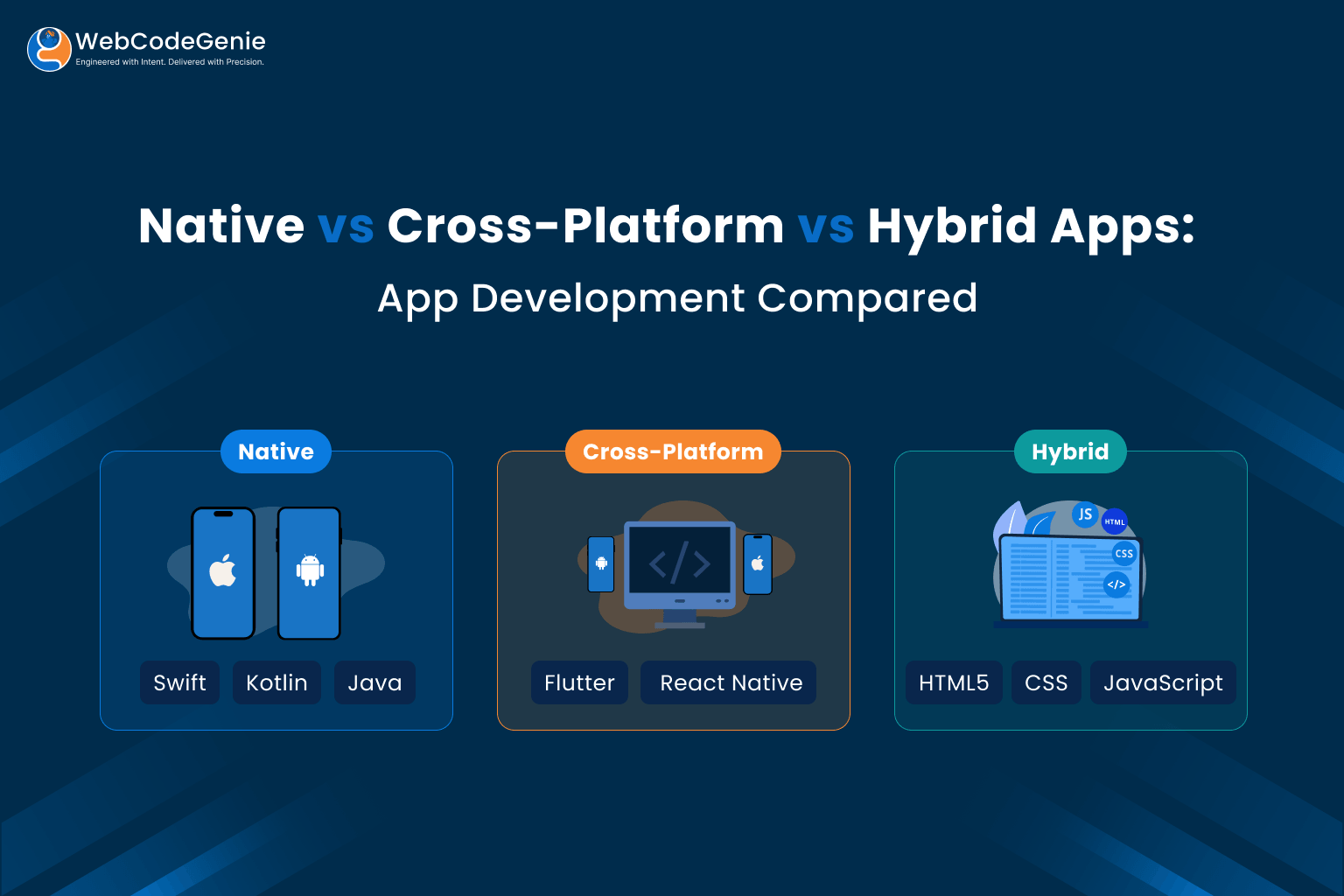
Choosing between native vs. cross-platform vs. hybrid apps is a critical business decision. It impacts how your app performs, how quickly you can launch, and how much you spend across development and maintenance.
Most comparisons focus on definitions. That does not help when you are working with fixed timelines, budget limits, and clear product goals.
In practice, the decision comes down to three factors: development cost and time, app performance comparison, and expected growth. Each approach handles these differently, and the right choice depends on what your product needs from day one.
AI features are starting to influence this choice as well. Apps that depend on real-time processing or heavy data handling often require stronger performance, which can affect the direction early in the planning stage.
Quick Comparison: Native vs. Cross-Platform vs. Hybrid
Before going deeper into each approach, a quick side-by-side view helps set direction. It gives you a clear sense of where each option stands on performance, cost, and timelines, so you do not evaluate everything from scratch.
This kind of snapshot is useful when you are narrowing down choices early or aligning internal teams before getting into detailed discussions.
| Factor | Native Apps | Cross-Platform Apps | Hybrid Apps |
| Performance | High | Moderate to High | Low to Moderate |
| Development Time | Longest | Moderate | Fastest |
| Cost | High | Mid-range | Low |
| User Experience | Best | Good | Basic |
| Scalability | Strong | Flexible | Limited |
The differences in native vs. cross-platform apps and any hybrid vs. native app comparison become clearer when mapped against actual product needs. Performance, timelines, and long-term flexibility tend to guide the decision.
Around this stage, teams also start thinking about execution quality. The outcome depends on how the app is planned and built, not just the approach itself. Aligned mobile app development services help ensure the chosen direction holds up under practical usage.
What Are Native Apps?
Native apps are built specifically for a single platform using platform-specific languages and tools. For example, Swift for iOS and Kotlin for Android. Each version of the app is developed and optimized separately.
This approach gives direct access to device features such as camera, GPS, sensors, and system-level APIs. As a result, native apps deliver strong performance and smoother interactions compared to other approaches.
When to Choose Native App Development Approach
- Performance-heavy applications
- Complex UI interactions and animations
- Apps requiring deep device integration
In many native vs. cross-platform app performance comparison scenarios, native apps hold an advantage when speed and responsiveness are critical.
AI-driven features also influence this choice. Applications that rely on on-device processing, real-time responses, or continuous data handling often perform better when built natively. This becomes relevant when evaluating which app development approach is best for long-term performance needs.
What Are Cross-Platform Apps?
Cross-platform apps are built using a single codebase that runs on multiple platforms such as iOS and Android. Frameworks like Flutter and React Native are commonly used to build and maintain these apps.
This approach reduces development effort since most of the code is shared. Teams can launch faster and manage updates across platforms without maintaining separate codebases.
About this point in evaluation, many teams begin exploring execution paths like Cross-platform app development, especially when timelines and budgets are clearly defined.
When to Choose the Cross-Platform App Development Approach
- Faster go-to-market
- Budget-conscious builds
- Products with moderate complexity
In most cross-platform app development vs. native decisions, this approach works well when you need a balance between speed and acceptable performance.
It also fits well for products that rely on API-based integrations, including AI features handled through cloud services rather than on-device processing.
What Are Hybrid Apps?
Hybrid apps are built using web technologies like HTML, CSS, and JavaScript, then wrapped inside a native container. They run inside a web view but are distributed through app stores like standard mobile apps.
Since most of the work happens in a shared web layer, development is faster and simpler compared to other approaches. However, this comes with trade-offs in performance and access to device capabilities.
When Hybrid Makes Sense
- Simple applications with limited interactions
- Internal tools used within organizations
- Products with basic UI and minimal performance needs
When looking at the difference between native and hybrid apps, performance and responsiveness are usually the biggest gaps. Hybrid apps depend on a browser layer, which can slow down complex interactions.
They are still a practical choice for use cases where speed of development matters more than advanced functionality or long-term scalability.
At this stage, the choice moves from definitions to trade-offs. A detailed comparison helps break down how each approach performs across areas that directly impact product success, from speed to long-term growth.
| Factor | Native Apps | Cross-Platform Apps | Hybrid Apps |
| Performance & Speed | High performance, smooth animations, direct hardware access | Good performance for most use cases, slight lag in complex scenarios | Limited performance, dependent on web view rendering |
| Development Time | Longer due to separate builds for each platform | Moderate, shared codebase reduces effort | Fastest, single codebase with web technologies |
| Cost of Development | Higher cost due to platform-specific teams | Mid-range, cost saved through shared development | Lowest cost, suitable for tight budgets |
| User Experience | Best-in-class, platform-specific UI and interactions | Close to native, with minor inconsistencies | Basic experience, limited interaction quality |
| Scalability | Strong, supports complex features and growth | Flexible, can scale with planning | Limited, struggles with complex scaling needs |
| Maintenance & Updates | Requires separate updates for each platform | Easier updates through shared codebase | Simple updates, but limited flexibility |
| Access to Device Features | Full access to all native APIs and hardware | Good access through plugins and bridges | Limited access, depends on plugins |
| Best Fit Use Cases | High-performance apps, enterprise systems, complex products | Startups, mid-scale products, faster launches | Internal tools, simple apps, quick deployments |
This comparison highlights how native vs. cross-platform vs. hybrid apps differ in areas that directly affect delivery and long-term viability. It also brings clarity to decisions around which app development approach is best based on actual product needs, not assumptions.
The next step is to understand how AI-driven features fit into this decision, especially when performance and data processing start to influence architecture choices early on.
How AI Features Influence Your Choice
AI features affect how your app handles processing, data flow, and response time. The development approach should support how these features are built and delivered, whether they run on-device or through external systems.
Native Apps
Native works well for advanced AI app development, especially when processing happens on the device.
- Real-time recommendations
- Image, voice, or video processing
- Low-latency interactions
- Offline AI capabilities
Direct access to hardware improves speed and consistency. This matters in any native vs cross-platform app performance comparison where real-time behavior is critical.
Native is also a strong fit for AI chatbot interfaces that require fast responses, especially when part of the logic runs locally.
Cross-Platform Apps
Cross-platform support for AI integration through APIs and cloud services.
- LLM-based features
- AI chatbots connected to external models
- Recommendation engines powered by backend systems
In most cases, the app acts as an interface while processing happens on external infrastructure. This works well for products using LLMs or chatbot systems where the heavy computation is not handled on the device.
This makes it a practical option in many cross-platform app development vs native scenarios.
Hybrid Apps
Hybrid can support basic AI integration, but with limitations.
- Simple chatbot interfaces
- API-driven automation
- Lightweight AI features
Since hybrid apps rely on a web layer, they are not suitable for advanced AI use cases or performance-heavy tasks. This becomes a constraint when evaluating which app development approach I should choose for AI-driven products.
The next step is aligning these choices with business goals, since the right approach depends on what you need to achieve first and how the product is expected to grow.
Choosing the Right Approach Based on Your Business Goals

The right choice depends on what you need to achieve first. Speed, cost, performance, and long-term growth do not carry the same weight at every stage. Align the approach with your current priorities, not assumptions.
For Startups
Startups usually focus on validation, faster launch, and controlled spending. The goal is to test the idea in the market without committing to heavy development upfront.
Around this stage, teams often explore structured MVP app development services to release a usable version quickly and gather feedback before scaling further.
For most early-stage products, cross-platform works well. It reduces build time and cost while still delivering a usable experience. This aligns with decisions around the best app development approach for startups.
For Growing Businesses
As the product gains traction, expectations shift. Performance, stability, and user experience start to matter more than just speed of delivery.
Cross-platform can still work at this stage, especially with proper architecture. Some teams also move specific features to native when performance demands increase. The decision becomes more about balance across development cost and time and product quality.
For Enterprise Applications
Enterprise apps require strong performance, reliability, and integration with existing systems. Long-term scalability becomes a key factor.
At this level, many businesses prefer native development for critical parts of the application. Dedicated builds aligned with iOS development services help maintain consistency and performance across Apple devices.
As coverage expands, similar focus applies to android development services, especially when dealing with a wide range of devices and user conditions.
Common mistakes often come from choosing based on short-term gains while ignoring long-term impact. The next section breaks those down so you can avoid costly rework later.
Common Mistakes Businesses Make While Choosing
Many issues with mobile apps do not come from poor development. They start earlier, at the decision stage. The wrong approach may still work at launch, but problems show up as the product grows.
Choosing Based Only on Cost
Lower upfront cost often leads teams toward hybrid or quick cross-platform builds. This works for simple use cases but can create limitations later.
If the product needs better performance or scaling, rebuilding parts of the app becomes necessary. That increases overall cost beyond the initial savings.
Ignoring Scalability
Some apps are planned for current needs without considering future growth. As features expand and user load increases, the chosen approach may not support the required complexity.
This becomes a concern in long-term scalability in mobile apps, especially for products expected to evolve.
Overestimating Cross-Platform Capabilities
Cross-platform frameworks have improved a lot, but they still have limits. Assuming they can handle every advanced feature without trade-offs can lead to performance gaps.
This often shows up during deeper app performance comparison, when the app handles complex interactions or heavy processing.
Underestimating Performance Needs
Performance issues are not always visible in early versions. They appear as usage increases or features become more complex.
Ignoring this during planning can affect user experience later, especially when comparing native vs. cross-platform app performance comparisons in practical conditions.
A clear decision framework helps avoid these mistakes and keeps the focus on what matters for your product.
Conclusion
The native vs. cross-platform vs. hybrid apps decision depends on how you prioritize performance, speed, cost, and future growth.
Native fits applications that demand high performance and deeper system access. Cross-platform works well for faster launches with balanced performance. Hybrid suits simple use cases with limited complexity.
Clarity on current priorities makes the choice easier and reduces the chances of rework later. The selected approach should support both immediate goals and planned growth so the product can scale without major constraints.


